All photographers believe they know composition. We learn the fundamentals in our basic photography courses. From time to time we may see an article giving us the top 10 techniques. Maybe in a workshop it was the hot topic for the day. For most of us, it’s something we know about, but something we’ve never really dug too deeply into.
What we do know about composition is that it’s the thing that makes a photograph work, or not.
Photography composition is a bit of a pseudoscience that taps into the worlds of art, biology, psychology, physiology, sociology, mathematics, history, education, painting, cinematography, and storytelling.
Let’s start with some general definitions for the word: composition.
Oxford English Dictionary: The action of putting together or combining.
Merriam-Webster: Arrangement into specific proportion or relation and especially into artistic form.
Cambridge Dictionary: The way that people or things are arranged in a painting or photograph.
Dictionary.com: The act of combining parts or elements to form a whole; the organization or grouping of the different parts of a work of art so as to achieve a unified whole.
Wikipedia: The organization of an artwork.
My simplified definition would be: organization of the elements.

Canon EOS 5DS R, EF 24-70mm f/2.8 L II USM | 1/500 SEC | F/5.6 | ISO 200
Without composition: a sentence is just a collection of random words, a song is nothing more than random notes tapped on a piano, and a painting is just piles of paint on a painter’s palette. With a nearly infinite combination of ways to combine the elements, and only a very small percentage of them being successful, the importance of composition becomes clear.
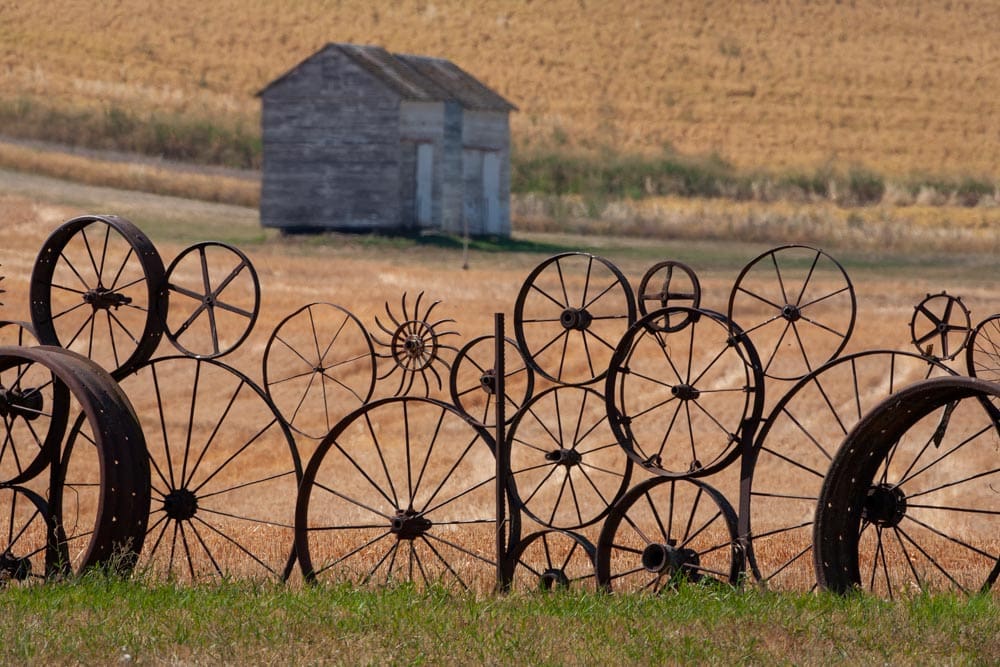
Dozens of repeating circles hold the frame together, while the lone shed gives the eye a place to land.
Canon EOS 5D, EF 500mm f/4 L IS USM | 1/125 SEC | F/16 | ISO 100
The word composition has been in use since at least the 1500s and has been used to describe literature, music, dance, mathematics, chemistry, and of course, photography. With each field enlisting different types of elements, it only makes sense that there would be slightly different definitions depending on the usage. Interestingly, there is no commonly accepted definition for “photographic composition.”
A proper photographic definition should cover all the bits and pieces that are in the photograph, where they are, and how they fit together. However, in photography we use techniques — such as shallow depth of field, fast shutter speeds, and lighting — that don’t change the arrangement of elements but do impact the message, story, or presentation of the final image.
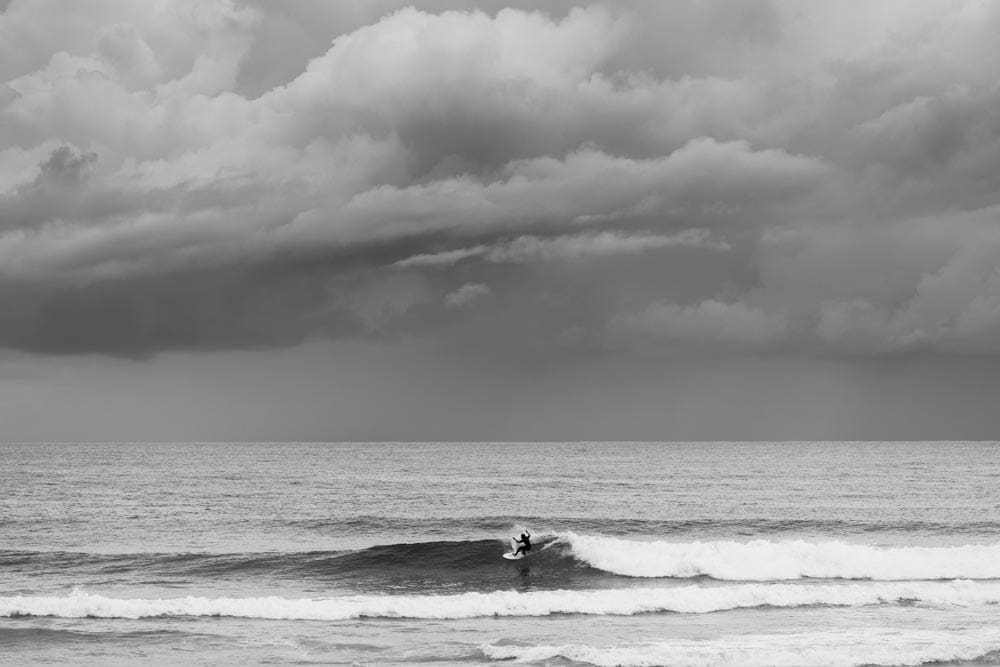
A vast sky and a tiny surfer — scale alone does most of the storytelling here.
Canon EOS R5, RF 100-500mm f/4.5-7.1 L IS USM @ 123mm | 1/400 SEC | F/6.3 | ISO 100
Composition vs. Technique
Setting a shutter speed and adjusting the aperture are part of technical photographic techniques. These techniques are fundamentally different from the type of tripod we prefer or the brand of light we use, because shutter speed and aperture choice will have a lasting effect on the visual and artistic qualities of the photograph.
In the movie industry, there is talk about putting the money on the screen. This means that the budget of the movie is focused on what appears on screen and not on other items like the quality of catering, the size of the actor’s trailers, or the budget for marketing.
As a photographer, it would seem anything that you do, or don’t do, that impacts your final image, should fall under the definition of “photographic composition.” So, it’s not just whether to put the bird in the upper left or right corner of the frame; it’s also the sharpness of the wings and the clarity of the baby chicks in the background.
In essence, composition is everything in photography that makes up your final image. It’s the primary reason why a photo is good, bad, or fantastic. A holistic approach to photographic composition allows us to include a wide collection of techniques, approaches, and ideas that will impact your final result. If you understand composition, you will understand what makes a good photograph.
My Definition
In my existing courses, I offer my own definition for “photographic composition.” Over the years, I’ve found that my definition has evolved as my understanding of the subject has grown. Currently, I have two definitions.
The short definition: Artistic arrangement of the parts of a picture.
The long definition: The use and structure of visual elements, techniques, and concepts that impact how a photograph is seen, understood, and received.
Lens choice, point of view, and timing are all part of classically defined composition. I believe depth of field, sharpness, lighting, color treatment, and even ISO are also part of composition. All of these are factors that play into the final result of every photo you take.
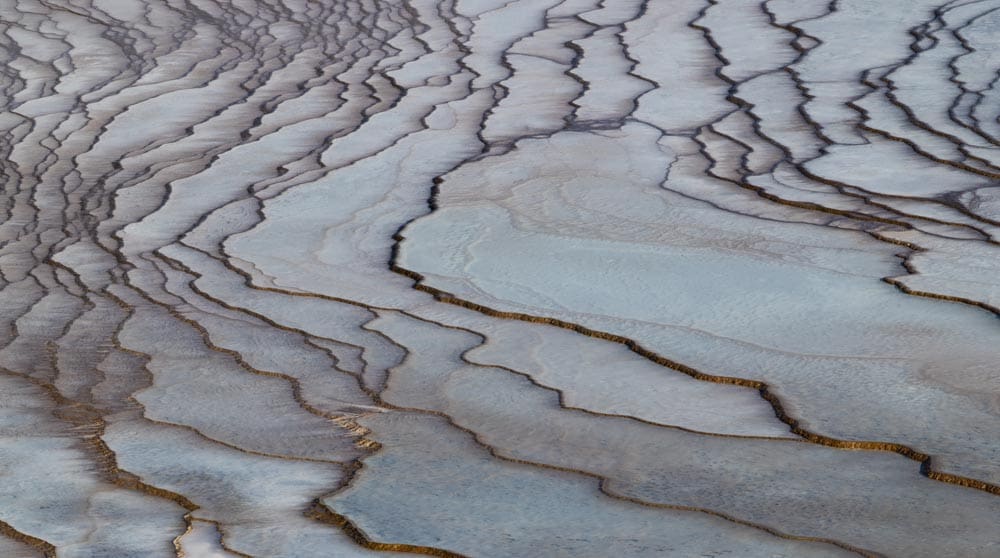
The terrace formed its own composition, patterns, texture, and all.
Canon EOS R5 Mark II, RF 100-300mm f/2.8 + RF 1.4x Extender @ 420mm | 1/640 SEC | F/8.0 | ISO 100
What’s Great About Composition
What I love most about photographic composition is that it’s limitless. Photography’s technical skills are complicated at first, but soon become a limited set of tools for achieving your vision.
Composition is not limited by the equipment you use, only by your knowledge and imagination. There are lots of established ideas you can rely on (perspective, figure/ground), but these are just the tip of the composition iceberg.
When you start to dig into the details and understand where these techniques came from and what they are based upon, you become more aware of how they can be applied and combined with other elements.
A New Composition Technique
I believe I’ve invented a new compositional technique. To the best of my knowledge, no one has ever described or taught this specific technique before. I know that there is a chance that I may be incorrect on this, but until I’m proven wrong, I’m sticking by this story.
Many years ago, I took a photo while on a canoe adventure in the far northerly reaches of Canada. My buddy and I were on the Mackenzie River, headed north from Great Slave Lake to the Arctic Ocean. Somewhere along the way, I’d hoped to get an equipment photo of all the gear we brought along with us. I’d been on the lookout for the right setting for a couple of weeks before I found a suitable location.
With all the right elements coming together, we unloaded the boat and lined up all our gear. As I positioned the tripod, I noticed that the lighting was looking really good. The wind was blowing and the clouds were moving quickly, which meant the light was changing. I wanted the boat in the shot, but there wasn’t time to haul it up from the shore. I motioned to my buddy to get in the shot while I triggered the self-timer and ran into position.
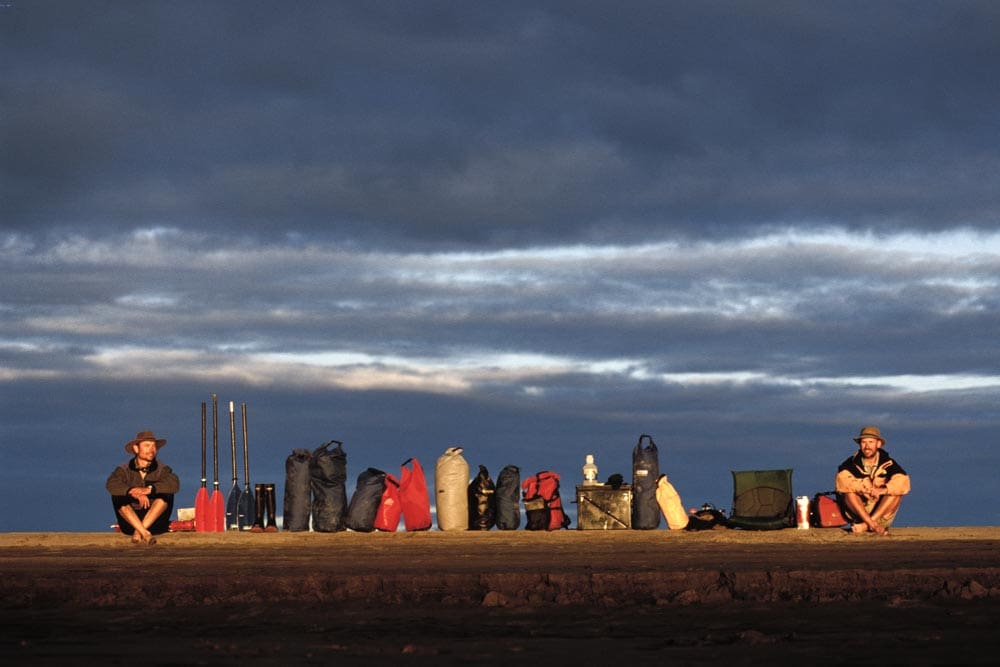
The photo that inspired the concept of Shadow Framing, August 2, 2001 — Tim Bailey (Left) and John Greengo (Right) on the Mackenzie River, Canada
Nikon N90s, Nikon 80-200mm f/2.8
The resulting photo was one of my favorites from the trip. It provided a great visual of the elements needed to pull off our extended time in the wilderness, but it was also, I felt, a compelling photograph.
For many years, I struggled to define why it was a good photograph. I know that it was a meaningful image to me, but why did I like it from a photographic standpoint? I no longer accept the statement “I like the photo, I just can’t say why.”
If you like a photo, you should know why. If you don’t know why, you have more to learn about photography and composition. I believe all good photographers should be able to analyze their photographs — and others’ — to identify the pros and cons of each of the elements and their effect on the whole.
When I started teaching photography, I started deep-diving into all the related topics like lighting and composition. After looking at the deeper meaning and significance of light and shadow and framing techniques in composition, I came back to the photo in question.
For the equipment photo, the combination of two elements — shadows and framing — helps set the scene, highlight the subject, and provide environmental context. “Shadow Framing” was born.
Shadow Framing is the use of shadows at the edge of the frame to lessen attention on less important areas and let your subject take the limelight.
The general idea of dark corners and edges in the frame is nothing new in photography; vignetting has been around since day one. Shadow Framing is a variation, a derivative, a more specific application stemming from other techniques.
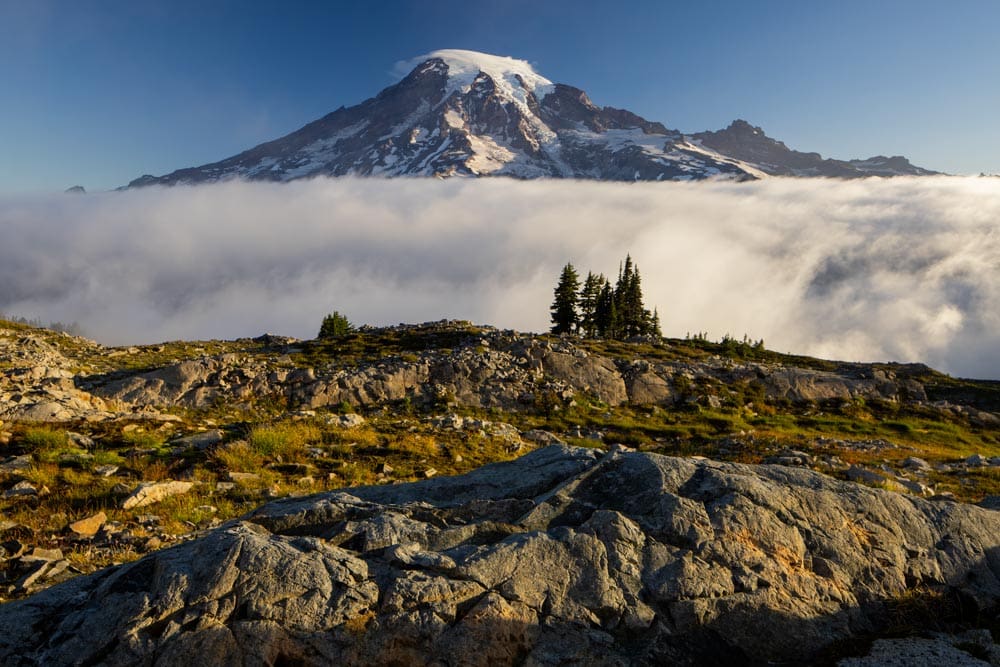
The slight inclusion of the shadow along the bottom of the frame acts as a soft border for the eyes to move back up to the more dominant subjects.
Canon EOS R5, TS-E 24mm f/3.5 L II | 1/25 SEC | F/10 | ISO 100
Shadow Framing works because the eye is drawn toward areas of brightness and away from areas of darkness. Dark edges of the frame allow the eye to explore and discover more about the scene, but eventually the eyes will be drawn back to the primary well-illuminated subjects. Unlike adding a vignette to an image, the shadow acts as a natural soft bumper gently guiding your viewer’s attention.
Secondly, the dark shadow along the bottom of the frame works like ballast to give a sense of stability. Dark on the bottom and light on top is the natural order of the world, just like the darker land below the bright sky.
Since this enlightenment, and after giving it a name, it’s become a part of my subconscious selection of tools that I have at my disposal. I’ve been able to look for it and find it in the field on many occasions. It’s become a favorite technique, right along with patterns, scale, negative space, and many other concepts.
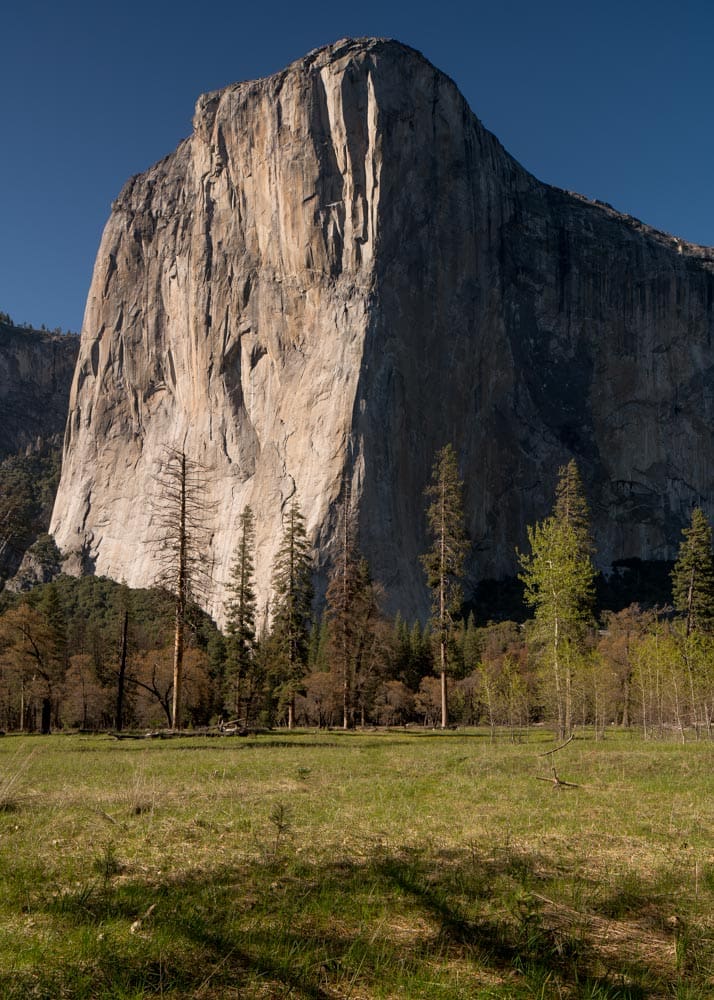
Without any compelling foreground material to include at the bottom of the frame, inclusion of the shadow lessens the impact of the bright grass.
Sony A7R II, Canon TS-E 24mm f/3.5L II | 1/100 SEC | F/8 | ISO 100
Applying Composition
I dislike the term “compositional rules” — and don’t get me started on the “Rule of Thirds” or “Rule of Odds”; we’ll save that for another time. In short, “rule” is a far more rigid term than it should be for this type of application. A much better term might be technique, theory, concept, or idea. The wide collection of compositional techniques is nothing more than a variety of ways to communicate effectively through visual means.
I believe it’s best to have a wide and deep appreciation for all the available options. Everything you will point your camera at will be in some way different from anything you’ve photographed before. When photographing something new, wouldn’t you like to have as many compositional options as possible?
I believe compositional techniques are like a set of tools for a tradesperson. The more tools you have, the more problems you can solve. When a problem arises, you don’t grab your favorite tool, then investigate the exact nature of the problem. You should first assess your current situation and then go to your toolbox (brain) to see if you have the right tool (technique) to solve the problem. The more familiar you are with your tools (compositional techniques), the more effective you will be.
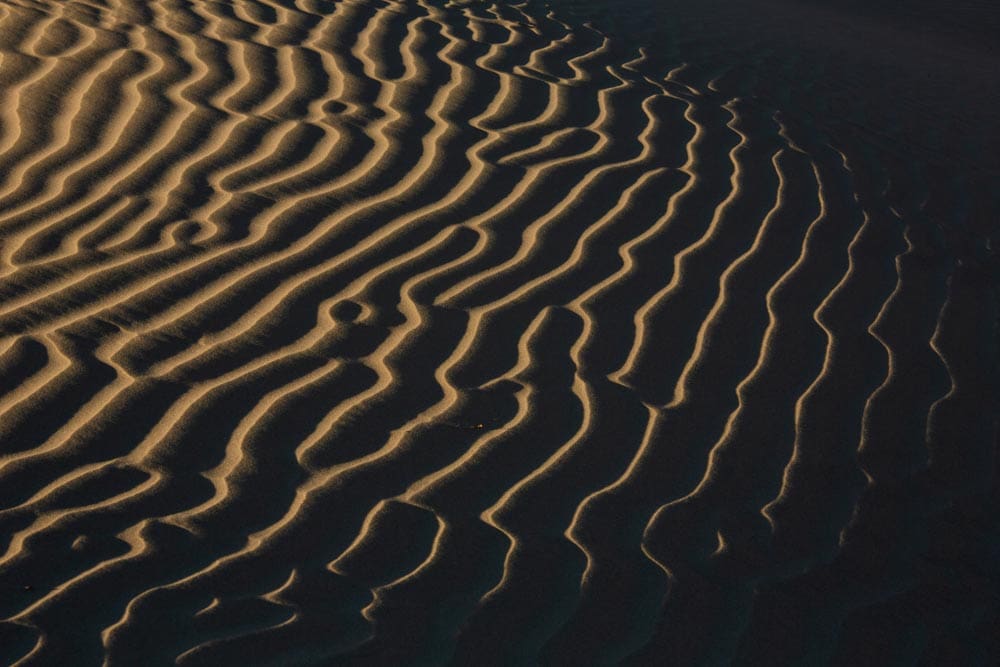
Sand, light, and shadow — nothing more — organized into a rhythm of repeating curves.
Canon EOS 5D Mark III, EF 70-200mm f/4 L IS USM @ 160mm | 1/25 SEC | F/16 | ISO 100
As mentioned before, photographic composition is an unlimited field; you don’t need to be limited to the known techniques of today. You can combine, derive, and invent your own concepts. This is perhaps the best part of photography — being creative.
I draw inspiration from all sorts of places for seeing and thinking about photographic composition. You might find it surprising, but I’ve discovered a great similarity between humor and photographic composition.
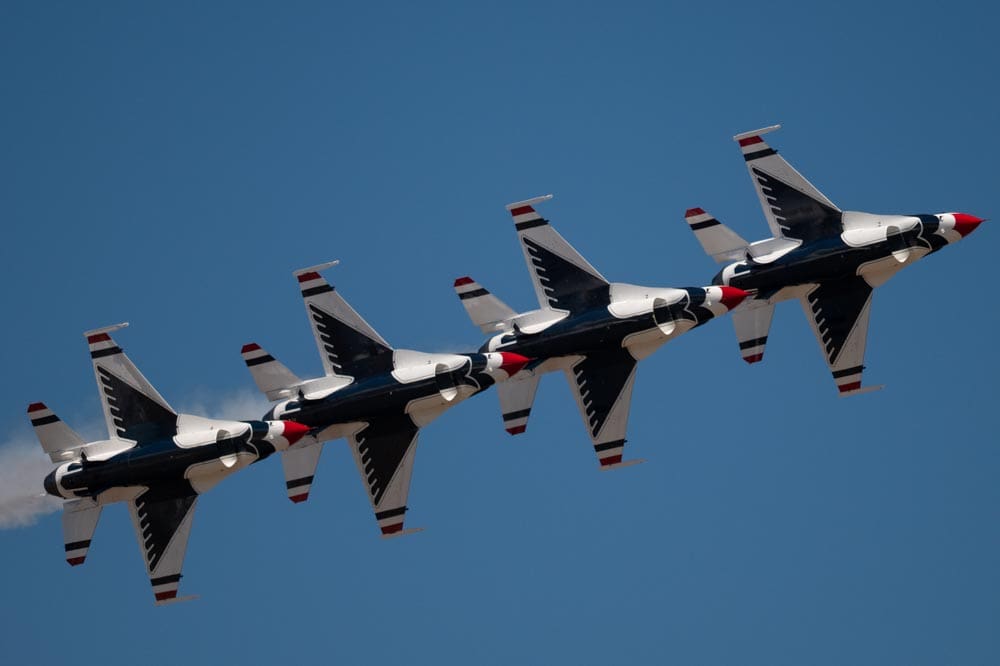
Four repeating shapes on a single diagonal line — pattern and direction working together.
Nikon Z8, Z 100-400mm f/4.5-5.6 VR S @ 400mm | 1/2000 SEC | F/5.6 | ISO 500
Humor, perhaps jokes in particular, is like a good photograph. A joke is frequently a short story — a series of words that, when placed in the right order and with the right timing, reveals a new and surprising perspective on the subjects involved.
Both a good joke and a good photograph are of subjects that we are typically familiar with, but with a creative composition of the elements, we are encouraged to see the material with a new perspective.
More to Come
This is the first of many articles I plan to write on this topic. I’ve started working on my next big project, and to no surprise, it will be a complete guide to composition.
I’ve been teaching photography for almost 20 years, and composition has always been a part of the curriculum, but I’ve always thought there’s more to the topic — one just needs to dig deeper to find it.
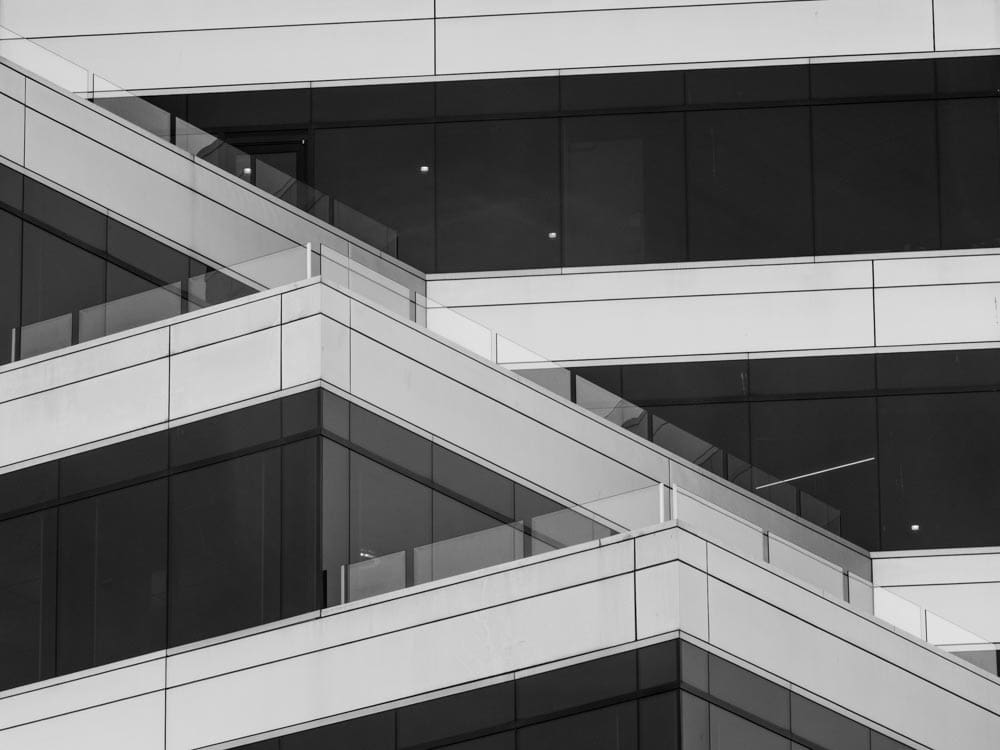
Strip away the color and the subject becomes pure line, shape, and angle.
Olympus E-M1 Mark III, M.Zuiko 40-150mm f/2.8 @ 125mm | 1/60 SEC | F/11 | ISO 200
This new course has been on my long-range plans for many years; I’ve just been waiting for the right window of opportunity. For the last 10 years, I’ve kept a manifest of ideas on the subject. I’m now doing more research and organizing my thoughts. So far, I’m up to 122 pages of notes. I’m finding myself going down some strange rabbit holes. Sometimes I find that I’m drifting a bit too far from the core subject, but other times I’m finding gems of information that clarify an existing idea or bring up a whole new possibility.
I’m diving into all the related fields mentioned earlier (art, biology, psychology, physiology, sociology, mathematics, history, education, painting, cinematography, and storytelling) for inspiration and ideas. I even have extended time set aside for traveling internationally so that I can capture new photos to help illustrate my rapidly expanding list of ideas.
How many compositional ideas can you name? I would expect most photographers could easily name 10; more experienced photographers might be able to name 25. So far, I’ve logged 214 ideas, concepts, and techniques that I think may be useful to the photographer fascinated with the topic. Increasing the photographic vocabulary and expanding the realm of possibility is a primary goal for the new course.
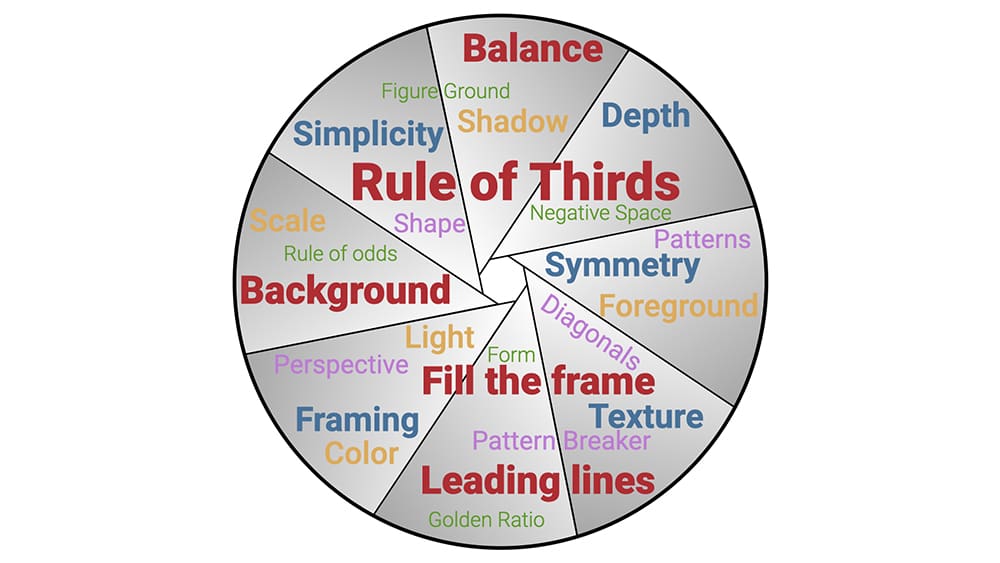
A small sample of the 230+ compositional ideas I’m cataloguing for the new course — this wheel barely scratches the surface.
I have lots to say on the subject, and these articles will serve as an outlet for some of the ideas that I’m working on for the new course.
I don’t have a release date at this time. I want to devote all the time, energy, and thought that I think it deserves before we go to production. I have seen a lot of material (articles, workshops, videos) on composition, and I want this new course to be the gold standard. I’ll keep everyone informed of my progress and any expected release time, but until then keep an eye out for more articles like this one.
I have high hopes for this upcoming course. Even at this point, I’m confident that it will be one of the most important courses I’ve ever released. Understanding and mastering photography always involves composition. The more you understand about the topic, the more you will recognize photographic potential.
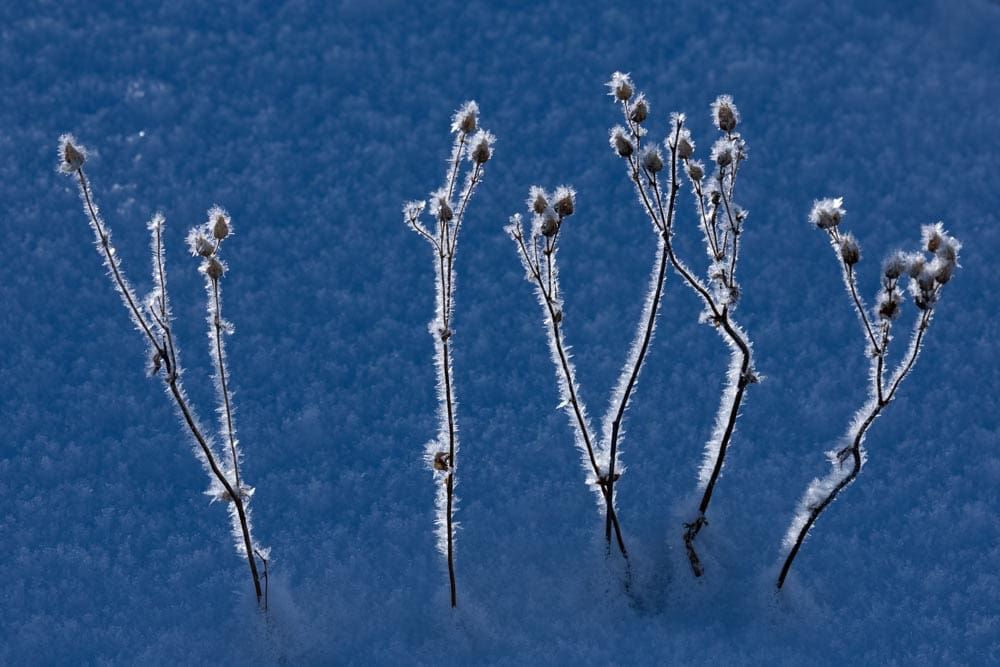
A handful of stems against a clean blue background — simplicity doing the heavy lifting.
Canon EOS R1, RF 100-300mm f/2.8 @ 260mm | 1/200 SEC | F/16 | ISO 100
What Do You Want? What Do You Have to Offer?
As I build the curriculum for my new course, what would you like to see addressed? Do you have a good idea for me to follow up on? Is there something from a related field that you’ve found inspirational and think I should look into?
Please leave a comment at the bottom of this page or send an email to info@johngreengo.com with your thoughts — I’m accepting and utilizing all available information at this time.
Become part of John’s inner circle
Sign up for the newsletter here — it’s free.
Want to become a better photographer?
Check out John’s selection of photography and camera classes here.